
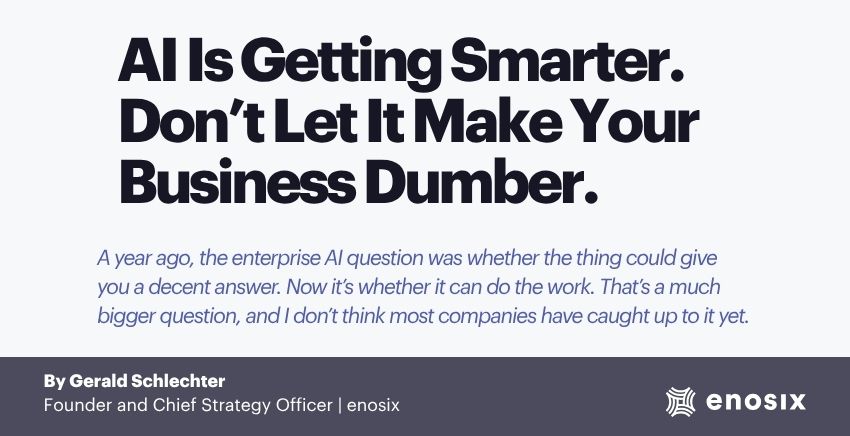
By Gerald Schlechter, Founder and Chief Strategy Officer of enosix, the SAP process virtualization company behind arnold® AI by enosix
Key takeaways
- AI interfaces are becoming a commodity, but the interface is not where a business decision gets committed.
- Most AI agent governance checks what an agent can access. It should also check whether the decision was right: which rule, which data, what limits.
- SAP ECC holds decades of pricing, availability, configuration and credit rules that AI agents need to make good decisions.
- SAP process virtualization lets AI run live SAP processes inside SAP, instead of copying SAP data or logic into a second system.
- The Bad Transaction Test gives you five questions to answer before an AI agent touches a live transaction.
At Dreamforce 2026, the enterprise software industry held what felt like a funeral for the fixed interface.
Salesforce’s AIforce vision takes the data, logic and permissions underneath the CRM and makes them available wherever people already work. Microsoft is moving the same way with Microsoft Copilot Cowork, which it says more than half the Fortune 500 is already using. ServiceNow is building AI, governance and workflow execution more deeply into its platform. And model builders keep making it easier for agents to reach into enterprise systems and act.
Different companies, different angles, one conclusion: the interface is becoming a commodity. I think they’re right. But here’s what none of those keynotes dwelled on: the interface isn’t where the decision gets committed.
A bad answer is annoying. A bad transaction hits the P&L.
In 2025, the enterprise AI question was whether the thing could give you a decent answer. Now it’s whether you can trust it to do the work. When an assistant fumbles a summary, a human usually catches it. When an agent acts, the human may already be out of the loop by the time the mistake becomes visible.
Picture it in an SAP environment. An agent prices a strategic account at list, promises inventory sitting in a plant on the other side of the world, extends credit your policy would never allow, or configures a product no factory can build. None of that stays in a chat window. It shows up in revenue, working capital, customer commitments and, eventually, the financial statements.
So the bar can’t be a plausible answer. It must be the right outcome for that company, at that moment, under the rules that run the business. The intelligence is new. The expertise underneath it isn’t.
Smart is getting cheap. Right is not.
AI agent governance: we’re governing the wrong thing.
Gartner expects the average global Fortune 500 enterprise to run more than 150,000 AI agents by 2028, up from fewer than 15 in 2025. I wouldn’t bet on the exact number, but I’d bet on the direction. Meanwhile, in Deloitte’s survey of 3,235 leaders across 24 countries, only 21% said their organizations have a mature governance model for agentic AI. Gartner also predicts that by 2027, 40% of enterprises will demote or decommission autonomous agents after governance gaps surface in production incidents.
Most of the governance conversation focuses on the agent itself: who built it, what it can access, what permissions it holds and what it logs. All of that matters. But everyone’s checking the agent’s badge. Not enough people are checking what it does once it’s inside.
An agent can be perfectly permissioned and meticulously logged and still make the wrong business decision. Which rule priced the order? Which plant is best suited to build it? Was the inventory live, or a copy from last night? What was the agent authorized to promise?
MCP, introduced by Anthropic in late 2024, is an important step in making systems accessible to AI. But access and execution are not the same thing. Connecting an agent to SAP gives it access. It doesn’t automatically give the ability to execute the pricing, availability and configuration logic your business has built over decades.
Access is getting easier. The complexity hasn’t gone anywhere. We’re governing agents. We should be governing decisions.
Your ECC system is more valuable to AI than you think.
The industry looks at SAP ECC and sees a countdown clock. SAP’s published dates end mainstream maintenance for ECC 6.0 on enhancement packages 6 to 8 on December 31, 2027, with paid extended maintenance through 2030. For years the message to ECC customers was essentially: migrate first, innovate later. SAP is now making limited Joule capabilities available to some on-premise ECC and S/4 customers during their transition, but the direction hasn’t changed. According to CIO, SAP says Joule is designed for Cloud, and access requires customers to shift at least 50% of their maintenance spending there.
That matters because migration remains hard. ASUG’s 2026 Pulse of the Customer Survey found budget constraints cited by 61% of respondents and integration challenges by 48%. I think there’s a more immediate question: what happens to the business expertise sitting inside ECC while that migration is still underway?
I’ve spent most of my career in and around SAP, and I understand why ECC can look overbuilt and ancient from the outside. Some of it is, and some of it should go. But much of what gets dismissed as legacy baggage is operating expertise, earned one decision at a time over decades. How do you price a strategic account? Which plant can build this configuration? How is inventory allocated when supply is tight? Which substitutions are acceptable? When does a decision need a human signature?
That knowledge rarely lives in a policy binder. It lives in master data, custom code and process rules that determine what gets built, shipped, billed and promised. The complexity companies have spent years complaining about is exactly the context an agent needs to make a good decision.
And this isn’t an ECC-versus-S/4 argument. Even an S/4 migration begins by identifying which long-tenured business rules must be preserved, redesigned or retired. Many large enterprises live with both systems for years. AI shouldn’t care which one happens to hold the process it needs to execute. The same customer, order or decision can cross both environments, and the answer still must be right.
Models will keep improving and intelligence will keep getting cheaper. The ability to apply your own company’s rules to a live decision isn’t something you buy off the shelf. ECC isn’t what stands between you and AI. In many companies, it’s where the expertise AI needs already lives.
The skeptic’s corner: common questions about AI and legacy SAP
Good. You should be skeptical. Let’s have the argument.
Isn’t this just nostalgia for old code?
No. Nostalgia is keeping old code because you’re sentimental about it. This is keeping the logic that prices your deals, allocates your inventory and keeps you from promising something you can’t deliver. Some of the old stuff is junk. Get rid of it. Just don’t confuse old with useless.
Why not rebuild the logic in a clean layer for AI?
You can, but you haven’t eliminated the complexity. You’ve copied it. Congratulations, you’ve built a second SAP. Now maintain both. When the two drift apart, your agent can be confidently wrong.
SAP has its own agents. Isn’t this SAP’s problem?
Only partly. SAP extending limited Joule capabilities to ECC customers during their transition is good news. But your people won’t live inside one AI interface. They’ll work in Microsoft, Salesforce, ServiceNow and platforms nobody has announced yet. The rules have to produce the same answer no matter who’s asking.
Doesn’t human approval solve this?
Only if the human is approving a decision built on the right information. A human signature on a confident guess is still a guess. It just has a paper trail.
SAP process virtualization: what governed AI execution looks like
For years, the answer to every new enterprise experience was another integration. Move the data. Recreate the logic. Build another layer and keep it synchronized with everything underneath it.
AI gives us a chance to rethink that. Stop copying the logic. Start asking the system that already knows the answer.
That idea is at the heart of how we built arnold® AI by enosix. Access to SAP is one thing. Executing the right SAP process is another. SAP already knows a great deal about how your business works, so let it execute the processes it already knows instead of teaching a second system to approximate them. We call it SAP process virtualization. SAP process virtualization means AI and applications run live SAP processes, such as pricing, availability, configuration and credit checks, inside SAP itself, rather than copying SAP data or logic into a second system.
The AI asks for an outcome, such as configuring a complex product, pricing an order, checking availability or processing a return, and arnold® AI turns that request into the actual SAP process, using the rules and approvals your business already relies on.
Some requests are too complex or ambiguous to execute safely in one step. Ask an agent to order 10 products, for example, and configuration, availability or pricing questions may need to be resolved before the order can be committed. That’s where the interface still matters. arnold® AI can pause the transaction, ask the missing questions through an inline conversational experience and use live SAP logic to confirm the right outcome before anything is committed.
enosix was one of nine partner plugins available at launch when Microsoft made Copilot Cowork generally available in June 2026.
We saw the difference in a real back-order workflow.
A customer service team at one of our customers spent roughly 35 minutes answering a question that sounds simple but carries real consequences: Will my order arrive on time? A late part can stop a production line.
Answering meant moving between CRM and multiple SAP screens, checking deliveries, production schedules, material availability and sourcing, then assembling it all into something the customer could use. The hard part was never finding the data. It was applying the right business logic to it.
Connected to arnold® AI, Microsoft Copilot Cowork asked SAP to do that work using the same live information and rules the business already trusts. Within minutes, the team had a nearly finished customer response and account summary. What had been a 35-minute information hunt became a review-and-decision exercise.
And it can go further. If the customer changes an item or places another order, the same interaction can move from answering to executing in SAP, under SAP’s rules. That’s when AI stops being an assistant that knows something about your business and starts doing real work inside it.
To see arnold® AI working inside Copilot Cowork, watch this demo video.
The Bad Transaction Test: 5 questions before an AI agent touches SAP
Before I’d let an agent touch a live transaction, I’d want good answers to five questions:
- Which rule made the call? Name the pricing condition or approval limit. “The model decided” is a failing answer.
- How fresh was the data? A live inventory position and a copy from last night are very different things.
- What action was it allowed to take? Discounts, credit decisions, promised delivery dates and other commercial commitments all need explicit limits.
- Can you replay it? Someone should be able to reconstruct what happened and why.
- Can you undo it? There must be a reversal path before the customer, the plant or the bank acts on a bad transaction.
The answers should determine how much autonomy an agent earns. A system that summarizes information and a system that books orders shouldn’t be governed the same way. That is consistent with Gartner’s argument that governance should vary with an agent’s level of autonomy and risk.
If you can’t answer these questions, you don’t have governed execution yet. You have an experiment with permission to transact.
The responsibility doesn’t move: accountability for AI stays with the business
Models will change. Agents will change. Interfaces will change again within a year. But the accountability does not move with them. The model provider does not answer for a wrong price, an impossible customer promise or a credit decision that should never have been approved. The business does.
So ask the question every company experimenting with agentic AI should be asking: How high are the stakes if your AI gets the work wrong? If the answer involves product configurations, revenue, inventory, production, customer commitments or financial outcomes, connecting the model isn’t enough. The operating logic underneath it matters just as much as the intelligence sitting on top.
Instead of another follow-up meeting, bring us the SAP workflow your AI can’t finish. Not the easy one. The one where it breaks. We’ll prove it against our system first, then take it into your SAP as an MVP under your rules.
You’ll get real proof, or a straight answer on why it isn’t ready yet.
Book a Working Session OR Download this Whitepaper
About Gerald Schlechter
Gerald Schlechter is Founder and Chief Strategy Officer of enosix. With more than two decades of experience in SAP environments, he has advised Fortune 500 companies on complex ERP landscapes and enterprise transformation, with a consistent focus on helping companies use the business logic they’ve already built rather than recreating it every time a new application or technology arrives.
About enosix and arnold®
enosix connects AI and modern applications directly to live SAP data, process, and business logic, in real time, without replicating it, migrating off it, or rebuilding what SAP already does well. Its technology works with SAP ECC and S/4HANA environments as they exist today, so companies can put their real SAP data, real SAP process, and real SAP business logic to work in whatever interface or AI experience people are using, without duplicating that logic anywhere else. arnold® extends that same real-time approach to enterprise AI, letting agents and AI experiences act on live SAP data, process, and logic while preserving the business rules, permissions, governance, and human judgment that consequential enterprise work still requires.
Related reading from enosix
- Enterprise AI That Can’t Execute Isn’t An Asset. It’s a Liability.
- SAP Clean Core Certification: What Level B Means for AI on SAP
- The Execution Gap in B2B Commerce
- Turn ECC Into Your Growth Engine Before You Migrate to S/4HANA
Company and product names referenced above belong to their respective owners; their use here is for commentary and identification only and implies no endorsement of, or affiliation with, enosix.
References
- Gartner, “Gartner Identifies Six Steps to Manage AI Agent Sprawl,” April 28, 2026.
- Gartner, “Gartner Says Applying Uniform Governance Across AI Agents Will Lead to Enterprise AI Agent Failure,” May 26, 2026.
- Deloitte Insights, “Business and IT leaders report AI agents are scaling faster than their guardrails,” 2026.
- Salesforce, Dreamforce 2026 keynotes, September 15–17, 2026.
- Microsoft, “Copilot Cowork: A new way of getting work done,” March 9, 2026.
- Microsoft, “Copilot Cowork is now generally available,” June 16, 2026.
- ServiceNow, “ServiceNow moves beyond the sidecar AI era,” April 9, 2026.
- Anthropic, “Introducing the Model Context Protocol,” November 25, 2024.
- SAP Support Portal, Business Suite 7 maintenance strategy.
- CIO, “SAP’s AI offer to legacy customers comes with a catch,” May 13, 2026.
- ASUG, 2026 Pulse of the SAP Customer Research.
Trademark notice: arnold® and enosix® are trademarks of enosix, Inc. SAP and other SAP products and services mentioned are trademarks or registered trademarks of SAP SE in Germany and other countries. Microsoft, Microsoft 365, Copilot and Copilot Cowork are trademarks of the Microsoft group of companies. Salesforce, Dreamforce, AIforce and Agentforce are trademarks of Salesforce, Inc. ServiceNow is a trademark of ServiceNow, Inc. Gartner is a registered trademark of Gartner, Inc. and/or its affiliates. Deloitte refers to Deloitte Touche Tohmatsu Limited and its member firms. Anthropic is a trademark of Anthropic, PBC. All other trademarks are the property of their respective owners.